Digital 2026 Life Coaching Journal
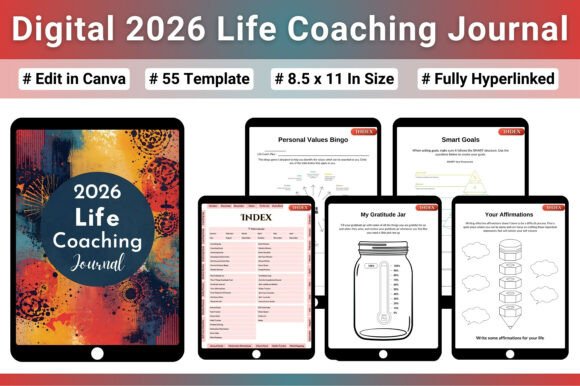
Planning for a new year often brings a mix of anticipation and uncertainty. You may have goals in mind, yet the path to achieving them can feel unclear without a structured approach. The Digital 2026 Life Coaching Journal offers a framework that bridges the gap between intention and action, combining goal-setting tools with mindset work in a single, fully hyperlinked PDF. Designed for anyone committed to personal growth, this 55-page resource provides both the structure to organize your year and the reflective space to understand what truly drives you.
A hyperlinked format that saves time and reduces friction
One of the most practical advantages of this journal is its fully hyperlinked design. Instead of scrolling through page after page to find a specific month or worksheet, you can jump directly to the section you need with a single click. This may seem like a minor convenience, but when you are in the middle of a busy week, the ability to move instantly between your year-at-a-glance, monthly planner, and weekly focus sheets can make the difference between actually using the journal and abandoning it after a few days.
The PDF is compatible with popular annotation apps like GoodNotes, Notability, and most PDF readers on iPad, tablet, laptop, or desktop. Whether you prefer handwriting your reflections with a stylus or typing directly into the document, the format adapts to your workflow. This flexibility means you are not locked into a specific device or app, which is especially useful if you switch between tools throughout the day.
Navigating without endless scrolling
For anyone who has tried to use a lengthy digital planner before, you know how frustrating it can be to lose your place. The hyperlinked structure eliminates that friction. You can click from the overview page to any month, then drill down to a specific week or worksheet, and return just as quickly. This creates a fluid experience that encourages regular use rather than adding another layer of administrative overhead to your day.
Life coaching tools that turn reflection into action
What sets this journal apart from a standard planner is the inclusion of life coaching frameworks that prompt deeper self-inquiry. Tools like the Wheel of Life assessment help you evaluate balance across key areas such as career, relationships, health, and personal growth. Rather than simply listing what you want to achieve, these exercises invite you to assess where you currently stand and identify which domains need more attention.
The core values worksheet pushes you to clarify what actually matters to you, not what you think should matter. This distinction is critical because goals that align with your core values tend to generate more sustained motivation. If you have ever set a goal only to lose interest weeks later, the issue may not be a lack of discipline but a misalignment between the goal and your deeper priorities.
Breaking down limiting beliefs
The journal includes a dedicated section for working through limiting beliefs and reframing them into empowering alternatives. This is not a superficial positive-thinking exercise. The structure guides you to identify the specific thought patterns that hold you back, examine the evidence for and against them, and then construct a more accurate and supportive belief. For example, if you often think I am not good at planning, the worksheet helps you explore where that belief came from and what small successes contradict it. Over time, this practice rewires the internal narratives that shape your daily choices.
Practical goal breakdown and habit building
Ambitious goals can feel overwhelming when viewed from a distance. The journal provides goal breakdown pages and action plan worksheets that help you deconstruct a large objective into manageable steps. Instead of a vague resolution like get healthier, you can define specific milestones, identify the habits that support each milestone, and track your progress week by week.
The habit-building templates are particularly useful for anyone who struggles with consistency. Rather than relying on willpower alone, these templates encourage you to design small, repeatable actions that fit into your existing routine. The weekly focus sheets then give you a space to review what worked and what did not, so you can adjust your approach without self-criticism.
Mindset reset pages for ongoing reflection
Personal growth is rarely linear. There will be weeks when your motivation dips or unexpected events disrupt your plans. The mindset reset pages are designed for exactly those moments. They offer structured prompts to help you step back, reassess your current state, and reconnect with your broader intentions. This built-in resilience practice means you are less likely to abandon your goals at the first sign of difficulty.
Who benefits most from this journal
Life coaches and therapists may find this journal useful as a structured tool to share with clients. It provides a ready-made framework for coaching sessions, allowing clients to work through core values, goal breakdowns, and limiting beliefs between appointments. This can deepen the coaching process without requiring you to design worksheets from scratch each time.
For individuals pursuing personal development on their own, the journal serves as a self-guided coaching experience. Entrepreneurs and freelancers who need to balance multiple projects may especially appreciate the ability to track both professional goals and personal wellbeing in one place. Students navigating transitions between academic stages can use the reflection prompts to clarify their next steps. The journal is also well-suited for anyone who has tried traditional planners and found them too rigid or too focused on scheduling rather than meaningful growth.
Where it fits best and where to consider alternatives
While the journal is comprehensive, it is worth considering your personal preferences before committing. The digital-only format is ideal if you already use a tablet or laptop for note-taking and planning. However, if you strongly prefer writing on paper and find screen-based reflection less engaging, a physical journal may feel more natural to you.
Additionally, the journal is designed for the 2026 calendar year, so it works best if you are planning specifically for that year. If you need a tool that is not tied to a specific timeframe, you might look for a more generic planner. That said, the year-specific structure provides a clear container for your goals, which can actually simplify decision-making by giving you a defined start and end point for each objective.
Practical use cases that demonstrate real value
Consider a marketing professional who wants to transition into a creative director role within the next two years. Without a structured approach, this goal can feel abstract and daunting. With the journal, they can use the Wheel of Life to assess current satisfaction across career, skills development, and networking. The core values worksheet might reveal that creative autonomy and continuous learning matter most, which then informs the types of projects to pursue. The goal breakdown pages help them define specific milestones: completing a certification by March, leading two campaigns by June, and building a portfolio by September. Each weekly focus sheet then keeps them accountable to the small actions that move these milestones forward.
Another example is a small business owner juggling operations, marketing, and client work. The habit-building templates can help establish a consistent morning routine for strategic planning, while the action plan worksheets keep quarterly initiatives on track. The mindset reset pages become valuable during stressful months when revenue dips or client demands spike, offering a structured way to regain perspective without spiraling into reactive mode.
Thoughtful observations on long-term growth
One of the more subtle strengths of this journal is how it combines structure with flexibility. The hyperlinked design and pre-built worksheets provide enough guidance that you never feel lost, yet the open-ended reflection prompts leave room for your own insights to emerge. This balance is harder to achieve than it sounds. Many planners err on the side of being too prescriptive, leaving little room for personalization, or too open, requiring you to invent your own system from scratch. The Digital 2026 Life Coaching Journal sits in a useful middle ground where the framework supports you without constraining you.
Another observation worth noting is the emphasis on mindset alongside goal setting. Many planning tools focus exclusively on what you want to achieve, but they ignore the internal barriers that prevent follow-through. By integrating mindset reflection, limiting belief work, and habit-building into the same document, this journal acknowledges that real transformation requires both external structure and internal clarity.
Making the most of the 55-page structure
To get the most value, consider starting with the core values and Wheel of Life assessments before diving into goal setting. This sequence ensures that your goals emerge from a clear understanding of your priorities rather than from external expectations. From there, use the goal breakdown pages to translate your priorities into specific, time-bound milestones. The monthly planner and weekly focus sheets then become your operational toolkit for staying on track throughout the year.
The journal also works well as a companion to other personal development practices. If you already journal daily or meditate, you can use the weekly focus sheets to reflect on insights from those practices and connect them to your broader goals. The hyperlinked structure makes it easy to revisit earlier entries and observe your own growth over time, which can be both encouraging and revealing.
For life coaches and therapists, integrating this journal into client work can create a consistent feedback loop. Clients can complete worksheets between sessions, bring their reflections to coaching calls, and track progress using the same framework. This continuity tends to accelerate the coaching process because clients arrive at sessions already having done some of the reflective work on their own.
Final thoughts on choosing the right planning tool
No single journal or planner works for everyone, and the Digital 2026 Life Coaching Journal is no exception. Its strength lies in combining coaching methodologies with practical planning tools in a format that reduces friction through hyperlinking. If you value structured reflection, clear goal breakdowns, and the ability to access your journal across multiple devices, this resource is likely to serve you well throughout 2026.
If you decide to use it, approach it as a living document rather than a one-time setup. Revisit your core values mid-year to see if they have shifted. Update your habit templates based on what you have learned about your own patterns. The journal is designed to evolve with you, and that iterative process is where the real growth happens. Whether you are a coach supporting others or an individual committed to your own development, the combination of structure and self-inquiry offered here provides a solid foundation for creating a meaningful and intentional year.