The Ultimate Book Planner: Your Complete Guide from Idea to Published Work
Every writer knows the feeling. A great idea arrives, full of energy and promise, and you jot it down with excitement. But somewhere between that first spark and a finished manuscript, the path gets muddy. Chapters feel disconnected. Word counts slip. The vision blurs. That is precisely where a structured planning system becomes invaluable. The Ultimate Book Planner is designed to bridge the gap between inspiration and completion, offering a step-by-step framework that keeps your project on track from the very first brainstorm to the final launch.
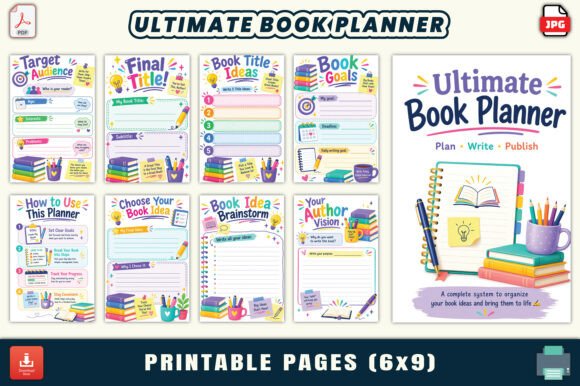
This 30-page resource, available in both high-quality JPG and print-ready PDF formats in a convenient 6 × 9 inch size, is more than a collection of worksheets. It is a thoughtful, visually engaging companion for anyone who wants to write a book without losing momentum. Whether you are drafting your first novel, compiling a nonfiction guide, or planning a professional ebook, this planner provides the structure to turn a scattered idea into a finished, publishable work.
The Art and Science of Planning a Book
Writing a book is often romanticized as a purely creative act. In reality, it is a project that demands organization, discipline, and clarity. The most successful authors, from debut self-publishers to seasoned professionals, understand that planning is not a limitation on creativity but a foundation for it. The Ultimate Book Planner embraces this philosophy by offering dedicated pages for author vision and goal setting right at the start. Before you write a single chapter, the planner asks you to clarify what you want to achieve, who you are writing for, and why this book matters now.
This upfront thinking is critical. It helps you avoid the common trap of writing 20,000 words only to realize your audience is unclear or your message lacks focus. By defining your target audience early, you make every subsequent decision about tone, content, and structure more intentional. The planner becomes a strategic tool, not just a diary of progress.
Why Book Planning Matters More Than Ever
The landscape of writing and publishing has shifted dramatically in recent years. Self-publishing platforms have lowered the barrier to entry, and the demand for niche, expert content has never been higher. Professionals, entrepreneurs, and creators regularly use books to establish authority, build email lists, and generate passive income. Bloggers turn their most popular content into guides. Coaches create workbooks for their clients. Educators develop resources for their students.
However, with this opportunity comes increased competition. A well-planned, well-structured book stands out. Readers can tell when a book has been thoughtfully organized. The Ultimate Book Planner responds directly to this need for intentionality. It is built for the modern creator who values their time and wants a streamlined system that integrates with both digital and print workflows. The availability of both JPG files for digital annotation and a print-ready PDF means you can work in whatever medium fits your daily habits, on a tablet, laptop, or with pen and paper.
What Makes the Ultimate Book Planner Different
There is no shortage of writing resources online. Templates, guides, and spreadsheets abound. What distinguishes the Ultimate Book Planner is its combination of completeness and simplicity. With 30 unique pages, it covers the entire lifecycle of a book project without overwhelming you with unnecessary complexity. The clean, minimal layout with colorful accents keeps the experience motivating rather than clinical. Each page serves a specific purpose, from brainstorming and title planning to chapter breakdowns, writing schedules, and editing checklists.
The planner includes practical tools that many writers overlook until they are deep in the process. Character and setting planners, for example, are included even though they are often seen as optional extras. For fiction writers, these pages are essential for maintaining consistency. For nonfiction authors, they can be adapted to plan case studies, examples, or key locations. The editing and proofreading checklists ensure that your final draft receives the same level of attention as your initial outline.
From Brainstorming to Publishing: A Guided Journey
The structure of the planner mirrors the natural progression of a book project. It begins with open-ended idea generation, giving you space to explore without judgment. From there, it guides you toward narrowing your focus, choosing a working title and subtitle, and breaking your concept into chapters. This is where many writers get stuck, but the planner provides a clear framework for building a detailed outline that will serve as your roadmap.
Once the outline is in place, the writing schedule and progress trackers come into play. These pages are designed for realistic, daily and weekly goal setting. Instead of vague intentions, you can track your word count, measure your consistency, and adjust your pace as needed. This kind of accountability is powerful, especially for writers balancing a book project with a full-time job, family responsibilities, or other creative work. The planner treats writing as a sustainable practice, not a sprint.
The later sections focus on preparation for editing and publishing. The editing checklist helps you move from a messy draft to a polished manuscript, and the marketing and launch plan pages encourage you to think about your book as a product from the start. This forward-looking approach is especially valuable for self-published authors who need to build anticipation and reach readers directly.
Practical Applications for Different Types of Writers
One of the planner's strengths is its versatility. Consider a freelance writer who wants to compile their best articles into a portfolio book. The brainstorming and chapter breakdown pages allow them to group content thematically and identify gaps that need fresh material. Or think of an entrepreneur who wants to write a lead-generation ebook for their service-based business. The target audience definition and marketing planning sections help them align the book's content with their ideal client's pain points.
A first-time novelist can use the character and setting planners to build a consistent fictional world, while the writing schedule keeps them moving forward even on days when inspiration feels distant. A blogger expanding into ebook publishing can repurpose existing content into a structured guide, using the outline and editing checklists to ensure the final product feels cohesive and professional.
In each case, the planner adapts to the user's context. It does not prescribe a one-size-fits-all method but instead offers a flexible structure that respects different workflows and creative styles.
How the Planner Supports Modern Writing Workflows
Today's creators often work across multiple devices and platforms. You might brainstorm on your phone during a commute, outline on a laptop in a coffee shop, and edit on a tablet at home. The Ultimate Book Planner accommodates this reality by being ready for both digital and print use. The high-quality JPG files can be imported into note-taking apps like GoodNotes, Notability, or OneNote, allowing you to write, draw, and annotate digitally. The print-ready PDF gives you the option of a physical binder or notebook that you can keep on your desk.
This flexibility is more than a convenience. It reflects a broader shift toward hybrid workflows where people choose the medium that best suits each stage of their process. Some writers find that the tactile experience of handwriting their outline helps them think more clearly. Others prefer the searchability and backup capabilities of digital notes. The planner supports both approaches without forcing a choice.
Recommendations for Getting the Most Out of Your Book Planner
To fully benefit from this planner, consider using it as a living document rather than a one-time questionnaire. Return to the vision and goal setting pages after you complete your first draft to see if your original intentions still hold. Update your marketing plan as you learn more about your audience. Treat the editing checklist as a conversation with your manuscript, working through each item thoughtfully rather than rushing to completion.
It also helps to establish a regular planning routine. Spend ten minutes at the beginning or end of each writing session reviewing your progress trackers and adjusting your schedule. This small habit builds momentum and prevents the drift that often derails long-form projects. The planner gives you a clear picture of where you have been and where you are going, which is invaluable when motivation wavers.
If you are collaborating with a co-author, editor, or beta reader, the planner can serve as a shared reference point. The chapter breakdown and outline pages make it easy to communicate your structure to others, and the editing checklist ensures that feedback is applied systematically.
A Tool for Sustainable Creative Work
Writing a book is a marathon, not a sprint. The most reliable way to finish is to build systems that support consistent, focused effort over time. The Ultimate Book Planner provides exactly that kind of support. It does not promise instant success or overnight bestseller status. Instead, it offers something more valuable: a clear, repeatable process that respects your creative energy while keeping you accountable to your goals.
For anyone serious about turning a book idea into reality, having a dedicated planning tool is a practical investment. It reduces the mental overhead of remembering what to do next and frees up cognitive space for the actual writing. The combination of brainstorming pages, detailed outlines, progress trackers, and publishing checklists means you never have to wonder what stage comes next. Everything is laid out, ready to use, in one place.
The Ultimate Book Planner is not just for people who have already started writing. It is equally valuable for those who have been thinking about a book for months or years but have not yet taken the first structured step. The brainstorming and goal setting pages provide a low-pressure way to begin. You do not need a perfect idea to start using this planner. You only need the willingness to explore and organize what you already know.
In a publishing environment where readers expect polished, well-structured content, the time you invest in planning is never wasted. It shows up in the clarity of your argument, the pacing of your narrative, and the professionalism of your final product. With the Ultimate Book Planner, you have a proven framework to guide you from idea to publication, one page at a time.