2026 Kids Chore Charts: A Strategic KDP Resource for Creators, Entrepreneurs, and Modern Families
In the evolving landscape of print-on-demand publishing and family productivity tools, the rise of structured, editable, and year-specific resources like the 2026 Kids Chore Charts marks a significant shift. Parents, educators, and caregivers are no longer satisfied with generic one-size-fits-all checklists. They demand tools that align with their child’s developmental stage, reflect the current calendar year, and offer flexibility in design. For creators and entrepreneurs on Amazon KDP, understanding the depth of this product goes beyond listing features — it’s about recognizing how a well-designed chore chart fits into broader trends in parenting, home management, and digital content creation.
This article explores what the 2026 Kids Chore Charts truly represents: a comprehensive, editable, print-ready system that addresses changing family dynamics, supports independent routines, and empowers creative professionals to deliver high-value products on Amazon KDP. Whether you are a seasoned publisher or a freelancer entering the low-content book space, this resource offers a strategic bridge between functional parenting tools and profitable digital assets.
What Are the 2026 Kids Chore Charts?
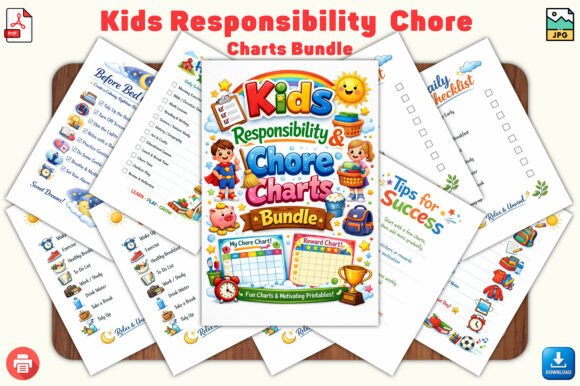
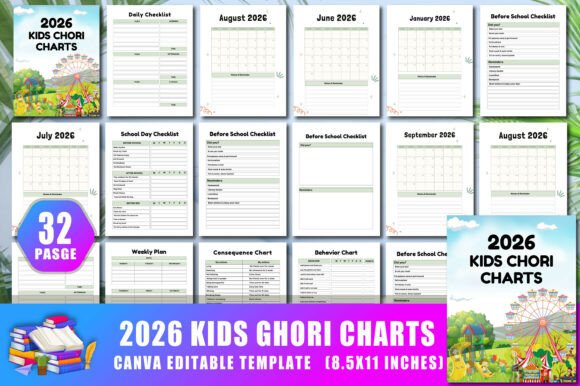
The 2026 Kids Chore Charts is a 32-page printable and editable collection built in Canva, designed to help children establish routines, track responsibilities, and build life skills throughout the year 2026. Unlike static PDF files, this product includes a fully editable Canva interior, allowing users — or buyers — to adjust colors, shapes, text, and layout before printing. It is optimized for Amazon KDP with high-resolution files (300 DPI), no bleed requirements, and a practical 8.5 x 11 inch trim size.
What sets this resource apart is its deliberate structure: it includes a personalized “Belongs to” page, a complete 2026 calendar with holidays, monthly spreads from January through December 2026, daily checklists, before-school and school-day routines, reward bucks, behavior and consequence charts, weekly plans, habit trackers, and multiple notes pages. This is not merely a chore chart — it is a year-long system for cultivating responsibility and independence.
For content creators and KDP entrepreneurs, the product’s editable nature is a game-changer. It allows you to customize the charts for different audiences, repurpose the design for future years, or offer a premium “ready to upload” PDF with the option for buyers to make their own tweaks. The combination of a unique design, high-quality print-ready files, and Canva flexibility positions this product as a versatile asset in the low-content publishing niche.
Why the Market Is Paying Attention to Year-Specific Chore Charts
The demand for 2026 Kids Chore Charts is driven by several intersecting trends. First, parents are increasingly seeking structured yet flexible tools to manage their children’s daily routines. The post-pandemic emphasis on home organization, self-regulation, and skill-building has elevated chore charts from simple checklists to essential home management tools. A year-specific chart adds relevance — it feels current, intentional, and grounded in the present.
Second, the Amazon KDP marketplace has matured, and generic designs no longer command attention. Buyers search for specific use cases: “2026 chore chart for kids,” “editable daily routine,” or “printable reward system.” By offering a product that includes a full 2026 calendar and month-by-month pages, creators meet a precise need that generic planners cannot fulfill. The inclusion of recognized holidays further anchors the resource in real-life family planning.
Third, the rise of Canva as a design platform for non-designers has transformed how products are created and sold. Entrepreneurs can now offer editable interiors that empower customers to personalize their purchase. This reduces friction for buyers who want to change a color, add a child’s name, or adjust a checklist. For creators, the editable Canva link means less pressure to predict every customer’s preference — you provide the framework, and they adapt it.
Changing Family Needs and the Evolution of Routines
Modern families operate on tight schedules. Parents juggle work, school pickup, extracurriculars, and household responsibilities. Children, even at a young age, benefit from clear expectations and visual cues. The 2026 Kids Chore Charts addresses these realities with a layered approach: daily checklists for mornings and evenings, school-day checklists, weekly plans, and behavior tracking.
One of the most practical inclusions is the “Before School Checklist” and “School Day Checklist.” These are often repeated in the product — intentionally — to reflect the reality that many families need multiple copies for different children or different times of the year. A single parent might print one for the fall semester and another for the spring, or use one for a younger child and another for an older sibling. The duplication is not a flaw; it is a design insight.
The “Reward Bucks” and “Reward Chart” sections tap into behavioral psychology, giving children tangible incentives for completing tasks. Meanwhile, the “Consequence Chart” and “Behavior Chart” set clear boundaries. This combination of positive reinforcement and accountability is a proven framework for building habits. For the KDP creator, this depth of functionality makes the product more valuable and less likely to be returned or rated poorly.
How the 2026 Kids Chore Charts Serves Creators and Entrepreneurs
If you are a professional content creator, freelancer, or entrepreneur in the print-on-demand space, the 2026 Kids Chore Charts offers a structured and scalable template. The 32-page count is ideal for KDP’s cost structure — low enough to keep production affordable, yet comprehensive enough to deliver real utility. The no-bleed requirement simplifies formatting, and the 300 DPI resolution ensures crisp, professional output whether buyers print at home or through a service like Amazon KDP.
The “Ready to upload” PDF files eliminate technical barriers. You can list the product within hours of finishing your interior design. At the same time, the editable Canva link gives you the flexibility to adjust the design for A+ content, create variations (such as a version for boys or girls, or different color palettes), or update the charts for 2027 and beyond. This reduces repetitive work and increases your catalog’s longevity.
Another key advantage is the product’s alignment with KDP’s low-content and medium-content categories. While a simple journal or notebook might feel disposable, a chore chart system is a tool that families use daily. That repeated engagement leads to better reviews, word-of-mouth referrals, and potential for repeat purchases (for example, when a parent buys a second copy for a summer routine).
Practical Examples of How the Charts Work in Real Life
Imagine a mother of two using the 2026 Kids Chore Charts to prepare for the new year. She opens the Canva link, changes the title font to match her home decor, adds her children’s names to the “Belongs to” page, and prints one set for each child. She uses the “Daily Chore Chart” to assign morning tasks (make bed, brush teeth, feed the dog) and the “Before School Checklist” to ensure backpacks are packed each evening.
As the year progresses, she refers to the “Habit Tracker” to monitor reading, water intake, or screen time limits. The “Reward Bucks” system lets her give points for consistent behavior, which can be exchanged for screen time or a small treat. When challenges arise, the “Consequence Chart” provides a non-emotional framework for accountability. By December, she has a full record of the year’s routines and habits — a valuable tool for parent-teacher conversations or setting goals for 2027.
For a KDP creator, this scenario illustrates why the product’s depth matters. It is not about listing features — it is about solving real problems. The “Notes” pages, repeated three times, allow parents to jot down observations, doctor appointments, or behavioral notes. The “Weekly Plan” helps with meal planning or activity scheduling. Each page serves a purpose, and the repetition of certain elements (like Notes and Checklists) reflects the reality that families need redundancy for different contexts.
Broader Industry and Consumer Trends Driving Relevance
The success of the 2026 Kids Chore Charts is part of a larger movement toward personalized, printable, and reusable home management tools. The global printable planner and organizer market continues to grow, driven by consumers who prefer digital customization over off-the-shelf stationery. Parents especially value the ability to tailor a product to their child’s personality, interests, and developmental level.
Additionally, the rise of “gentle parenting” and “conscious parenting” has shifted the conversation around discipline and responsibility. Chore charts are no longer seen as punitive but as collaborative tools that teach time management, accountability, and self-efficacy. Elements like “Behavior Chart” and “Consequence Chart” are framed in positive terms — they help children understand natural outcomes without shame.
From a technology perspective, the integration of Canva as a delivery mechanism is significant. Canva’s dominance in the design space means that a vast pool of creators, even those without formal design training, can produce professional-grade products. The editable link model also aligns with the growing preference for digital products that offer lasting value — a buyer can return to the link year after year to reprint or adjust pages.
Why This Product Matters for Your KDP Strategy
If you are building a catalog on Amazon KDP, the 2026 Kids Chore Charts represents a smart addition for several reasons. First, its specificity — the 2026 year — creates a natural sense of urgency and relevance. Buyers looking for “2026” resources in late 2025 and early 2026 will find this product highly relevant. Second, the 32-page length is optimized for KDP’s minimum page count requirements while keeping printing costs low, allowing you to price competitively and maintain healthy margins.
Third, the inclusion of both editable Canva files and ready-to-upload PDFs gives you flexibility in how you market the product. You can sell the PDF version as a low-maintenance listing, and offer the Canva link as a bonus or upsell. Some entrepreneurs even use the editable version to create spin-off products — for example, a “2026 Kids Chore Charts – Editable” listing and a separate “2026 Kids Chore Charts – Ready to Print” version.
The high-quality JPG and PNG files add further value for buyers who want to print single pages or use the charts digitally on a tablet. The practical 8.5 x 11 inch size fits standard binders and frames, making it easy to integrate into existing home organizational systems.
Final Observations on Content Creation and Utility
The 2026 Kids Chore Charts is more than a printable — it is a thoughtful system that bridges the gap between parenting needs and entrepreneurial opportunity. Its strength lies not in any single feature but in how those features work together to support a child’s daily, weekly, and monthly routines. The calendar, the checklists, the reward systems, and the tracking tools form a coherent whole that evolves with the year.
For creators, the lesson is clear: the most successful KDP products are those that understand the user’s context. By offering a year-specific chore chart with editable flexibility, you acknowledge that families are not the same from year to year. Children grow, schedules shift, and priorities change. A resource that can adapt — while still offering immediate, print-ready utility — is a resource that stays relevant.
As you consider your next content project, look at the 2026 Kids Chore Charts as a model of thoughtful product design. It includes a “Belongs to” page to establish ownership, a full 2026 calendar with holidays for forward-looking planning, monthly spreads for seasonal goals, daily and school-day checklists for consistency, reward and consequence charts for behavioral balance, habit trackers for long-term growth, and ample notes pages for reflection. Each element has a purpose, and together they form a product that serves both the parent and the child.
Whether you are a creator looking for a ready-to-upload interior or an entrepreneur seeking a customizable template to build your brand, this chore chart system delivers practical value in a competitive marketplace. The combination of Canva’s flexibility, KDP’s distribution power, and a well-researched page structure makes it a compelling addition to any low-content publishing portfolio.