Building Handwriting Skills with Early Writing Practice for Kids
Handwriting is one of the first structured skills young children encounter, and how they approach it often shapes their attitude toward learning for years to come. Early Writing Practice for Kids is a thoughtfully designed workbook that addresses this critical phase. It is not simply a collection of tracing pages; it is a sequential system that moves a child from basic pencil control to forming letters, words, and complete sentences. For parents, educators, and caregivers guiding children through preschool, kindergarten, or early home learning, this resource provides a clear pathway to develop fine motor skills, letter recognition, and writing confidence.
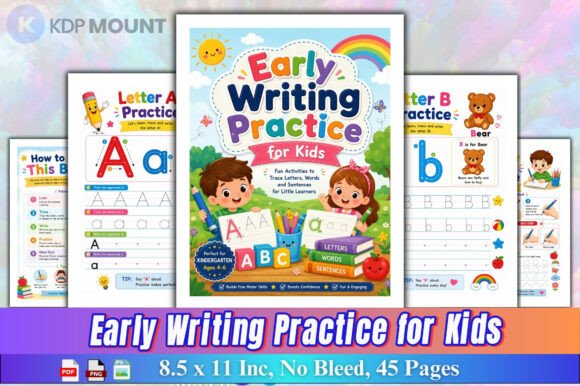
The workbook stands apart because it treats early writing as a process, not a single activity. It begins with pre-writing exercises—straight lines, curves, zigzags, and shapes—before introducing individual letters. Each letter includes uppercase and lowercase recognition, stroke direction guides, and tracing practice. From there, the learner progresses to sight words, word tracing, and finally sentence writing. This structure mirrors how children naturally develop motor control and literacy, making the workbook a practical fit for daily routines, classroom centers, or homeschool blocks.
Where This Workbook Fits in the Learning Process
Understanding where Early Writing Practice for Kids fits into a broader educational workflow helps adults use it more effectively. Consider a typical week for a preschool or kindergarten learner. The child may already be engaging with alphabet books, phonics games, read-aloud sessions, and fine motor activities like playdough or cutting with scissors. This workbook serves as the bridge between those informal experiences and the formal skill of handwriting.
It can be introduced before a child begins writing on lined paper, as its pre-writing sections build the necessary hand strength and control. Many parents find that completing the pre-writing pages for a few weeks makes the transition to letters far smoother. The workbook can also be used during a daily learning block—perhaps ten to fifteen minutes per day—as a warm-up for other literacy tasks. After a child finishes a lesson, the workbook provides immediate feedback: they can see their own progress through completed pages, which reinforces motivation.
For educators managing a classroom, the workbook complements a structured literacy curriculum. It pairs well with phonics instruction by aligning letter tracing with the sounds being taught. It also works alongside scaffolded teaching methods where the adult models a letter, the child traces it, and then the child attempts it independently. The stroke direction guides on each letter page are especially useful for teachers who need a consistent visual cue for all students.
Practical Implementation Tips for Parents and Educators
Getting the most out of Early Writing Practice for Kids requires thoughtful integration into your routine. Here are several practical approaches that have worked for families and classrooms:
Start with the Pre-Writing Section
Do not skip the pre-writing pages. The pencil grip practice, straight lines, curved lines, zigzag lines, and shape tracing are not filler—they are the foundation. A child who cannot comfortably draw a straight line will struggle with letter formation. Spend at least one week on these pages before moving to letters. If the child shows frustration with a particular shape, return to it the next day. The goal is fluency, not speed.
Use the Personalized Pages to Build Ownership
The workbook includes a "This Book Belongs To" page where children can write their name. Let them complete this page first, even if their writing is messy. It creates a sense of ownership and signals that this book is theirs. For young learners, seeing their own name on the cover of a workbook is powerful. It also gives you a baseline sample of their handwriting to compare against later pages.
Establish a Consistent Routine
Handwriting improves with regular, brief practice rather than long, infrequent sessions. Aim for ten to fifteen minutes per day, ideally at the same time. Many families integrate it after a morning read-aloud or before a screen-time reward. In a classroom setting, it works well as a morning entry task or as part of a literacy center rotation. Consistency matters far more than duration.
Pair with Other Tools and Resources
This workbook interacts well with other learning materials. For letter recognition, use alphabet flashcards or a letter chart alongside the tracing pages. For fine motor development, combine workbook time with activities like using tweezers, threading beads, or molding clay. For pencil grip, a triangular pencil or a grip aid can reinforce what the workbook teaches. The workbook is not a standalone solution; it is a central component of a broader motor and literacy development system.
Understanding the Workflow from Start to Finish
To see how Early Writing Practice for Kids functions as a complete process, consider a typical progression through the workbook:
- Introduction and Setup – The child opens to the welcome pages and the "How to Use This Book" section. An adult reads the instructions aloud and demonstrates how to hold a pencil. The child writes their name on the personalized page.
- Pre-Writing Skills – Over several days, the child practices pencil grip and traces straight lines, curved lines, zigzags, waves, and basic shapes (circle, square, triangle). This builds hand strength, coordination, and confidence.
- Letter by Letter – Each letter of the alphabet gets dedicated pages. The child sees the uppercase and lowercase forms, follows the stroke direction guide, traces the letter multiple times, and then attempts free writing. This pattern repeats for all 26 letters.
- Building Words – After letters, the workbook introduces sight words and word tracing. The child moves from individual letter formation to connecting letters into recognizable words. This step reinforces both handwriting and early reading skills.
- Sentence Writing – The final section presents simple sentences for tracing and independent writing. The child now applies all the skills developed earlier in a meaningful context. This is where fluency begins to emerge.
This sequence is deliberate. Each stage prepares the child for the next. If a learner struggles at the word tracing stage, the adult can identify whether the issue lies with letter formation (return to the letter pages) or with fine motor endurance (return to the pre-writing shapes). The workbook's structure makes this diagnostic work straightforward.
Factors That Influence Long-Term Success
Several factors determine how well this workbook integrates into a child's development over the long term. Paying attention to these from the start saves time and reduces frustration.
Preparation and Environment
Set up a dedicated writing space. A child-sized table and chair, good lighting, and a flat surface make a measurable difference. Keep a pencil sharpener, eraser, and a few different pencil types nearby. Some children prefer a slightly thicker pencil barrel when they are just starting. Prepare the workbook by opening it to the correct page before the child sits down. This reduces transition time and keeps the focus on the activity.
Compatibility with a Child's Development Level
Not all four-year-olds are ready for handwriting practice. Observe whether the child can hold a crayon with a tripod grip, can imitate a vertical line, and shows interest in scribbling or drawing. If these are not yet present, spend more time on gross motor and fine motor play before introducing the workbook. For children who are ready, the workbook's incremental difficulty allows them to move at their own pace.
Usability and Adult Involvement
The workbook is designed for adult guidance. Young children cannot typically follow the instructions alone, and that is expected. The adult's role is to model how to form each shape and letter, provide verbal cues, and offer encouragement. Over time, the child will gain independence. A useful workflow is: the adult demonstrates, the child traces, the adult observes, the child practices, and the adult gives specific feedback ("Your circle is getting smoother" rather than "Good job").
Organization and Bookkeeping
Keep the workbook in a consistent place. Use a page marker or sticky note to track progress. Some parents take a photo of the completed pages every few weeks to document improvement—this is motivating for both the child and the adult. For educators, having a class set of workbooks organized by student name makes it easy to pull them during parent-teacher conferences or progress reports.
Quality Control and Observing Progress
One of the strongest features of Early Writing Practice for Kids is how it makes progress visible. Each page is a data point. You can see whether the child's strokes are becoming more controlled, whether letter reversals are decreasing, and whether pencil pressure is consistent. This allows you to make informed decisions about when to move to the next section or when to repeat a page.
If a child consistently struggles with a particular letter, do not move past it. Return to the stroke direction guide. Practice the letter in isolation using a whiteboard or sand tray before returning to the workbook page. The workbook is not a race; it is a tool for mastery. Quality control means prioritizing correct formation over speed. Many children develop bad habits like starting letters from the bottom or using an awkward pencil grip. The workbook's clear guides help adults catch these early and correct them.
Integrating into a Busy Routine
For adults managing work, household responsibilities, and multiple children, finding time for one-on-one learning activities is challenging. The workbook is designed for short, focused sessions. A parent can sit with a child for ten minutes while dinner cooks. A classroom teacher can use it during independent practice while working with a small group. The key is to treat it as a integration tool rather than an extra task. When the workbook becomes part of the daily rhythm—like brushing teeth or reading a bedtime story—it stops feeling like something to schedule and becomes something automatic.
For homeschoolers, the workbook pairs naturally with a morning basket or a learning binder approach. Include it alongside a letter of the week theme, a phonics game, and a related craft. For example, if the week focuses on the letter M, the child traces M pages in the workbook, sorts pictures of things that start with M, and makes a handprint mouse craft. The workbook reinforces the same letter in a different format, deepening retention.
Long-Term Value and Next Steps
After a child completes Early Writing Practice for Kids, they will have built a solid foundation in handwriting. They will be ready for lined paper, longer writing assignments, and more complex literacy tasks. The fine motor skills developed through tracing and pencil control will also support other areas like drawing, using scissors, and eventually typing. Many children who complete this workbook transition to journal writing or simple story prompts with greater ease.
For adults, the workbook offers a record of the child's growth. Flipping back to the early pages—where a line was shaky and a circle looked more like an oval—provides a tangible measure of progress. That evidence is valuable for conversations with teachers, pediatricians, or occupational therapists if questions about development arise.
Ultimately, Early Writing Practice for Kids is not just about handwriting. It is about giving a young learner the tools to express themselves on paper. When a child writes their own name for the first time or copies a sentence they understand, they experience a sense of capability that fuels further learning. The workbook provides the structure; the adult provides the encouragement. Together, they build a skill that will serve the child for a lifetime.