600 Stress Management Journal Prompts: A Practical Guide to Building Emotional Resilience
Stress doesn't announce itself with a warning label. It shows up as the knot in your stomach before a deadline, the irritation that flares up during a conversation with a colleague, or the exhaustion that settles in after months of saying yes to everything. You've probably tried apps, breathing exercises, or motivational quotes, but something deeper is usually going on beneath the surface. That's where journaling with structured prompts becomes genuinely useful.
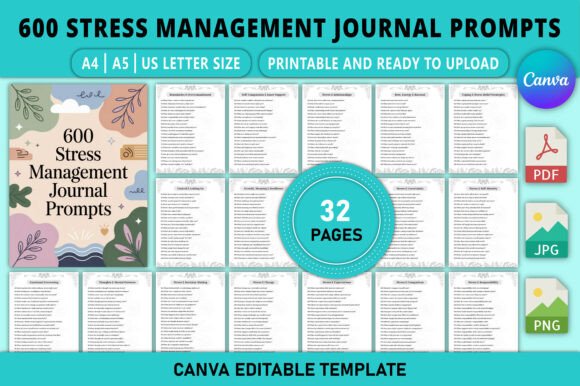
The 600 Stress Management Journal Prompts bundle offers exactly that: a comprehensive set of guided questions designed to help you identify what's actually triggering your stress, process those emotions, and build healthier patterns over time. Whether you're using it for yourself, your clients, or your audience, the editable Canva format means you can tailor everything to fit your exact needs without starting from scratch.
Where This Journal Fits Into Real Life
Most people don't sit down to journal when everything is going well. They reach for it when they're overwhelmed, stuck, or unsure what to do next. The 600 Stress Management Journal Prompts is built for those moments, but it also works as a daily practice to prevent burnout before it takes hold.
For Personal Use: When You Need Clarity or Calm
Imagine you've had a week where work demands piled up, a family member needed extra support, and you barely had time to breathe. You open the journal and see prompts under Identifying Stress that ask straightforward questions about what's weighing on you right now. Not vague prompts, but specific ones that help you untangle the mess in your head.
The Emotional Processing section becomes useful when you're holding onto frustration or sadness but can't quite name why. Instead of spiraling, you work through prompts that guide you to label the emotion, explore its source, and decide what you actually need. Over time, this builds emotional resilience because you're not just venting. You're learning how your mind works under pressure.
For someone dealing with burnout and exhaustion, the Rest, Energy, Burnout category offers prompts that help you separate rest from avoidance. You begin to notice whether you're genuinely resting or just collapsing into distractions. Small shifts in awareness lead to better daily habits, and the journal keeps you accountable without judgment.
For Therapists, Coaches, and Counselors: A Ready-Made Resource
If you work with clients who struggle to articulate their stress, prompts like the ones in Self-Compassion or Thoughts and Mental Patterns can open conversations that feel less intimidating than direct questions. You can assign specific categories between sessions, and clients come back with reflections that give you real material to work with.
The Boundaries and Overcommitment section is especially valuable for people-pleasers or those juggling multiple responsibilities. Prompts here help clients recognize patterns like saying yes out of guilt or fear, and they give you a starting point for teaching healthier boundary-setting in a practical way.
Because the journal is fully editable in Canva, you can customize the fonts and layout to match your practice's branding, or even pull specific prompts to create targeted worksheets for different client needs. It saves hours of content creation while keeping the quality high.
Professional and Business Use Cases You Might Not Have Considered
Beyond personal growth and therapy, this journal bundle works across several professional settings where stress management is a real need.
Entrepreneurs, Freelancers, and Small Business Owners
Running a business means living with uncertainty. The Stress and Uncertainty and Control and Letting Go categories are particularly relevant when you're waiting on client payments, launching a new product, or pivoting your strategy. Prompts here help you separate what you can control from what you can't, which reduces the mental load of constant decision-making.
Freelancers often face time pressure and irregular income, both of which appear in dedicated sections: Time Pressure and Money Stress. Instead of worrying in the abstract, you write through specific prompts that help you spot patterns in how you react to financial stress or deadline anxiety. Over weeks of consistent use, you start noticing earlier warning signs and responding instead of reacting.
The editable format means you can rebrand the entire journal as a lead magnet, a client gift, or a paid product for your own audience. Change the title, adjust the colors to match your brand, and publish it as a digital planner or printable. It's KDP-ready, so you can also upload it to Amazon as a low-content book without spending weeks designing from scratch.
Educators and Workshop Facilitators
Teaching stress management to students or workshop participants requires materials that are structured but flexible. The 600 Stress Management Journal Prompts covers 19 distinct categories, from Stress and Relationships to Stress and Decision-Making, so you can pull relevant prompts based on your curriculum. If you're running a workshop on emotional regulation, you might focus on Coping and Stress-Relief Strategies combined with Self-Compassion. If the topic is workplace burnout, Responsibility and Expectations become your core sections.
Because the prompts are already written and organized, you save planning time while still offering participants a cohesive experience. You can also edit the Canva file to add your own prompts, remove sections that don't fit, or combine categories to create a custom workbook for each cohort.
What to Consider Before Choosing This Journal
No journal is magical by itself. The prompts work best when you use them consistently, even if it's just five minutes a day. Some people prefer to answer one prompt per day to build a habit. Others like to sit down once a week and work through several prompts in a category that feels relevant at that moment. Both approaches work, and the 600 prompts give you enough variety to keep going for months without repetition.
The Growth, Meaning, and Resilience section is worth mentioning here because it shifts focus from managing stress in the moment to finding meaning in difficult experiences. This is the kind of long-term reflection that builds genuine resilience, not just quick fixes. If you're someone who tends to skip reflective work when you're busy, set a reminder or pair the journal with a weekly review routine.
For those using the editable Canva version, take advantage of the customization. Adjust the language to match your tone, whether that's clinical, conversational, or warm. If you're publishing for a specific audience, consider which categories they'd find most relevant and rearrange the order accordingly. The flexibility is a real advantage, but only if you actually use it.
Categories That Address Specific Stress Triggers
The 19 categories cover a wide range of stress sources, but a few stand out for their practical relevance in daily life.
Stress and Comparison speaks directly to the social media era where everyone feels behind. Prompts here help you examine why comparison triggers you and how to reframe your focus without dismissing the feeling.
Stress and Change addresses transitions like moving, job changes, or relationship shifts. Instead of generic advice about embracing change, the prompts walk you through what specifically feels threatening and what resources you already have to adapt.
Stress and Motivation is useful when you're stuck in procrastination or apathy. These prompts distinguish between genuine lack of motivation and stress-induced paralysis, which is a distinction most productivity advice misses.
Stress and Safety covers emotional and physical safety concerns, including environments where you feel unsupported or threatened. This is a category that therapists and coaches will find especially valuable for clients dealing with trauma or high-stress workplaces.
Stress and Expectations tackles both internal pressure you put on yourself and external expectations from family, work, or society. This section alone can shift how you approach goal-setting and self-talk.
Practical Tips for Getting the Most Out of the Prompts
Set a regular time, even if it's brief. Morning journaling can set a calmer tone for the day, while evening journaling helps you process what happened and release it before sleep. The prompts work either way.
Don't feel obligated to answer every prompt in order. Let your current situation guide which category you choose. If you're dealing with a difficult conversation, go to Stress and Relationships. If you're feeling stuck in your career, Stress and Decision-Making or Expectations might be more useful.
Review your past entries occasionally. Seeing how your responses evolve over weeks or months reveals patterns you might miss day to day. That awareness is where lasting change starts.
If you're using the journal as a product for your audience, consider including a brief guide or sample prompts in your marketing to show the depth and practicality of the content. People want to know that the prompts are specific, not generic. Share real examples from categories like Coping and Stress-Relief Strategies or Emotional Processing to demonstrate value.
Why This Bundle Works Across Different Life Situations
The most useful stress management tools are the ones that adapt to where you are today, not where you think you should be. The 600 Stress Management Journal Prompts covers enough ground that you'll find relevant prompts whether you're navigating a major life transition, dealing with chronic low-level stress, or simply wanting to understand yourself better.
For the parent balancing work and family, the Responsibility and Time Pressure categories offer practical reflection without guilt. For the recent graduate facing uncertainty about the future, Control and Letting Go and Uncertainty provide grounding. For the creative professional struggling with motivation, Self-Identity and Expectations help untangle perfectionism from genuine passion.
The journal doesn't promise to eliminate stress. It promises to help you understand it, process it, and respond to it with more clarity and less reactivity. That's a realistic outcome, and one that builds over time with consistent use.
A Note on the Editable Format
The fact that this bundle is fully editable in Canva and available in A4, A5, and US Letter sizes means you can adapt it to your exact workflow. Print it as a physical journal you carry with you. Keep it as a digital file you type into on your tablet. Or use it as a template to create products for your own business. The KDP-ready formatting also means you can publish it as a low-content book on Amazon without spending days on layout.
If you're customization-minded, change the title, adjust the colors to match your brand or mood, and even add your own prompts to sections that feel incomplete for your needs. The structure is solid on its own, but the flexibility makes it yours.
Stress management isn't about fixing yourself. It's about understanding the patterns that keep you stuck and making small, consistent adjustments. The 600 Stress Management Journal Prompts gives you the structure to do that work, whether you're doing it for yourself, your clients, or your audience.