Structured Creativity: How the Sci-Fi Writing Prompts Workbook Builds Immersive Science Fiction
Science fiction demands a rare blend of disciplined structure and wild imagination. You need logic to build a believable world, yet you also need the audacity to break known physics, reimagine society, or invent a new kind of intelligence. Many writers find themselves stuck between these poles—too structured and the story feels sterile; too freeform and it collapses into incoherence. The Sci-Fi Writing Prompts Workbook exists precisely at this intersection. It offers a scaffold for your imagination, a place where guided prompts and open-ended exploration coexist. Whether you are a veteran novelist or a teen just beginning to sketch star systems, this workbook provides a practical tool for generating, refining, and connecting story ideas. The pages are not empty—they are invitations, each one a small launchpad aimed at a different corner of the universe.
Why Prompts Matter More Than Empty Pages
Blank pages can paralyze even experienced writers. The problem is not a lack of ideas; it is the overwhelming number of choices. A prompt acts as a constraint that liberates. When the Sci-Fi Writing Prompts Workbook asks you to describe how a first-contact scenario might unfold between a species that communicates through bioluminescent patterns and a human diplomat who is colorblind, it narrows your focus just enough that creativity can flow. The prompt gives you a friction point—a specific tension to work with—without dictating the outcome. This is the workbook's core value: it provides direction without imprisoning your voice. The 80 pages are packed with such scenarios, each designed to push you into unfamiliar territory so that you discover characters and conflicts you would never have found on your own.
The Psychology of Guided Creation
When you sit down with a guided prompt, your brain shifts from a state of diffuse anxiety to focused problem-solving. You are no longer asking "What should I write about?" but instead "How does this particular alien civilization respond to this particular crisis?" That shift is powerful. It mirrors how professional writers develop series—by setting up a premise and then exploring its logical implications. The workbook trains you to think like a world-builder from the first line. Over time, this habit becomes internalized, and you begin generating your own prompts effortlessly. But in the early stages, having a physical or digital workbook with pre-written scenarios is like having a writing partner who never runs out of ideas.
World-Building Through Constraint
One of the most challenging aspects of science fiction is constructing a setting that feels both alien and internally consistent. The Sci-Fi Writing Prompts Workbook tackles this through prompts that force you to make choices about technology, ecology, culture, and history. For example, a prompt might read: "In a city built entirely on a frozen methane ocean, the ruling council uses a currency based on stored heat. Describe a day in the life of a citizen who is running out of warmth." This single sentence demands you think about economics, climate, architecture, class structure, and daily survival. The workbook does not give you the answers—it gives you the question, and that is where the learning happens. By working through multiple such scenarios, you build a mental toolkit for constructing worlds that feel real, regardless of how fantastical their surfaces appear.
Technology as Character
Another strength of the workbook is its treatment of technology not as background noise but as an active force in storytelling. Prompts frequently ask you to consider the ethical, social, and personal implications of a new invention. What happens when a time traveler accidentally changes a minor historical event, only to return to a present where a different language is spoken? How does a society function when artificial intelligence manages all emotional labor, leaving humans to pursue only rational tasks? These are not just exercises in speculation—they are rehearsals for the kind of thematic writing that makes science fiction resonate with readers. By working through these prompts, you learn to treat technology as a character with its own agency and consequences.
Character Exploration Across Dimensions
Science fiction characters often bear the weight of representing entire species, ideologies, or futures. That can make them feel flat if you are not careful. The Sci-Fi Writing Prompts Workbook helps you avoid this pitfall by embedding character depth directly into the prompts. Instead of saying "write about an alien," it says "write about an alien archivist who has been preserving Earth's literature for centuries, but has never met a human." Suddenly, the character has a profession, a history, a hidden longing, and a relationship to humanity that is both intimate and distant. This is the kind of specificity that generates memorable characters. The workbook includes dozens of such character-centered prompts, covering roles like ambassador, pilot, engineer, rebel, historian, and child.
Emotional Truth in Alien Settings
Readers connect with stories through emotion, not technology. The prompts in this workbook consistently return to emotional core conflicts—loss, belonging, identity, trust, sacrifice—even when the setting involves warp drives or parallel universes. One prompt might ask you to describe a farewell between two beings who exist in different time streams and can only communicate once every century. The science fiction frame makes the emotion more powerful because the stakes are amplified by the scale of the universe. By practicing this kind of storytelling, you learn to make the strange feel intimate and the cosmic feel personal.
Practical Use Cases for Different Creators
The Sci-Fi Writing Prompts Workbook is not limited to one type of writer. Its flexibility comes from the open-ended nature of the prompts. Here are several ways different users might integrate it into their creative practice:
- Novelists can use the workbook to develop side stories, generate material for short story collections, or break through writer's block during long projects. A single prompt can spark an entire subplot or reveal a hidden aspect of a main character.
- Educators and homeschoolers will find the workbook valuable for teaching narrative structure, speculative thinking, and thematic writing. The prompts are clean and age-appropriate, making them suitable for classroom discussions or independent assignments.
- Teens and young writers benefit from the workbook's low-pressure format. There is no judgment, no word count requirement—just a page and a prompt. This builds confidence and fluency over time.
- Game masters and role-players can adapt the prompts to build campaign worlds, generate NPC backstories, or create quest hooks. The sci-fi setting fits seamlessly into many TTRPG systems.
- Content creators and bloggers working in the sci-fi space can use the prompts as starting points for articles, videos, or social media threads. The ideas are rich enough to support short-form and long-form content alike.
Navigating the Workbook's Structure
Understanding how the Sci-Fi Writing Prompts Workbook is organized helps you use it more effectively. The 80 pages are divided into themed sections that cover the major subgenres of science fiction. Early prompts focus on foundational concepts like first contact and alien biology, building your comfort with speculative thinking. Middle sections introduce more complex elements such as time loops, multiverse mechanics, and post-human societies. Later prompts encourage you to combine multiple concepts—technology with culture, ecology with politics, memory with identity. This progression mirrors the natural arc of developing as a writer: you start with ideas, move into combinations, and finally arrive at synthesis.
Page Design for Real Writing
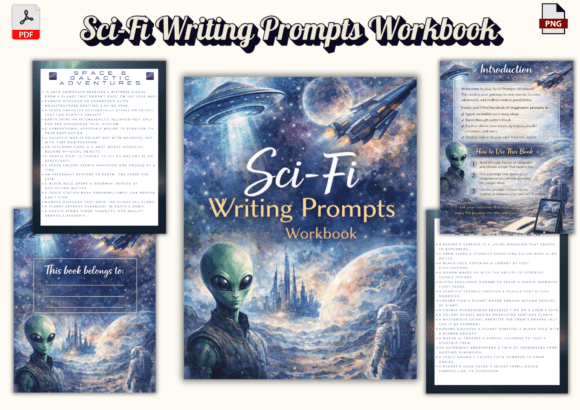
Each prompt page includes space for drafting, brainstorming, and expansion. This is not a book you read—it is a book you write in. The guided prompt appears at the top, followed by lined or boxed areas where you can sketch scenes, outline plots, or jot down dialogue. There are also dedicated notes pages for longer reflections. The 8.5 x 11 inch format provides generous room for handwriting, and the high-resolution design ensures that digital use on tablets remains crisp. Whether you print the pages or work directly in a PDF annotation tool, the layout encourages sustained engagement rather than quick answers.
Overcoming Common Writing Obstacles
Every writer faces specific hurdles, and the workbook addresses them directly. If you struggle with starting, the prompts eliminate that first barrier. If you struggle with depth, the prompts are designed to require more than a surface-level response—they push you to consider implications, history, and perspective. If you struggle with variety, the workbook cycles through different subgenres and narrative angles so you do not fall into repetitive patterns. And if you struggle with finishing, the workbook's structured progression helps you see a prompt through from initial idea to expanded scene or story sketch. Over time, these small victories build momentum for larger projects.
From Prompt to Published Work
Many published short stories and novels began as responses to prompts. The Sci-Fi Writing Prompts Workbook supports this pipeline by including pages specifically labeled for expansion and drafting. When you find a prompt that resonates, you have space to develop it immediately—capturing the initial spark and the early details before they fade. Later, you can return to these pages and pull together a more polished piece. The workbook thus functions as an idea bank, a first draft generator, and a reference tool all in one. For writers who participate in challenges like NaNoWriMo or themed writing months, having a pre-populated workbook of stimuli can be a game-changer for maintaining daily output.
Why This Workbook Stands Apart
Writing prompt books are common, but few are built with the depth and intentionality of this one. The prompts do not lean on clichés or surface-level gimmicks. They are crafted to provoke genuine storytelling dilemmas. The workbook also avoids over-directing—it does not tell you what to think about the scenario, only what the scenario is. This respect for the writer's autonomy is rare. Additionally, the Sci-Fi Writing Prompts Workbook covers a broad enough range that you can return to it repeatedly without exhausting its material. A prompt you encountered six months ago may yield a completely different story now, because you have grown as a writer. The workbook grows with you.
Digital and Print Flexibility
Because the workbook is delivered as a high-resolution PDF and PNG, you can use it in whatever format suits your workflow. Print the whole book and bind it. Print single pages as needed. Import it into note-taking apps like Goodnotes, Notability, or OneNote. Project pages in a classroom setting. The flexibility means the workbook adapts to your environment rather than forcing you into a particular method. This is especially valuable for educators who need to share prompts with students across different devices and platforms.
Building a Sustainable Writing Practice
The long-term value of the Sci-Fi Writing Prompts Workbook lies in how it cultivates a habit. Writing regularly is the single most important factor in improvement, and prompts reduce the friction of starting. If you commit to one page per day, you will have generated 80 distinct story seeds by the time you finish the workbook. Some of those seeds will wither, but others will grow into stories, chapters, or even novels. More importantly, the act of responding to prompts trains your brain to notice story opportunities everywhere—in news articles, in scientific discoveries, in everyday conversations. The workbook is a temporary scaffold that builds a permanent skill.
Connecting to the Broader Sci-Fi Community
Many writers use prompts as social catalysts. Sharing your responses in writing groups, forums, or social media communities invites feedback and collaboration. The Sci-Fi Writing Prompts Workbook is ideal for this purpose because its prompts are specific enough to generate interesting discussions but open-ended enough that multiple writers can respond to the same prompt in wildly different ways. Comparing those responses is a powerful learning experience. It reveals how much of storytelling comes from individual perspective and how much from shared craft conventions. The workbook thus becomes not just a private tool but a bridge to community engagement.
Final Thoughts on Choosing Your Next Creative Companion
Every writer needs a reliable method for generating ideas and developing them into coherent narratives. The Sci-Fi Writing Prompts Workbook offers a structured yet flexible approach that respects your creative autonomy while providing the spark you need to begin. Its 80 pages cover the full spectrum of science fiction storytelling—from first contact to time travel, from alien cultures to futuristic technologies—and each prompt is designed to push you toward deeper character work, richer world-building, and more satisfying narrative arcs. Whether you are a seasoned author seeking fresh material, a student learning the craft, or a hobbyist exploring strange new worlds, this workbook gives you a space to write boldly and explore without fear. The universe is waiting. All you have to do is open the first page.