Multiplication Workbook Mastery: Building Math Confidence for Grades 2-5
In an era where digital distractions compete for every minute of a child’s attention, the quiet power of a well-structured Multiplication Workbook is making a serious comeback. Parents, educators, and entrepreneurs who build learning tools are recognizing something critical: math fluency isn’t just about getting the right answer—it’s about building the cognitive infrastructure for logical thinking, pattern recognition, and problem-solving. The 🔢 Multiplication Master Multiplication Workbook for Grades 2-5 is a standout example of how thoughtful design can turn a foundational academic skill into a genuine confidence builder. But to understand why this workbook matters, we need to step back and look at the bigger picture of how math learning is evolving and why mastery of multiplication tables remains a non-negotiable skill in both academic and real-world contexts.
Why a Multiplication Workbook Still Matters in a Digital Age
It might seem counterintuitive to invest in a physical workbook when countless apps and online games promise to make learning multiplication fun. Yet the demand for structured, print-based resources is stronger than ever. Parents and teachers report that screen-based learning often leads to passive consumption rather than active recall. A Multiplication Workbook demands something different: focused attention, sequential progress, and the satisfaction of completing a page by hand. The 🔢 Multiplication Master Multiplication Workbook for Grades 2-5 taps into this need by providing a tactile, distraction-free environment where students can build mental math muscles without the ping of notifications or the lure of autoplay videos.
This shift in preference reflects a broader trend in education and parenting: the return to intentional, low-tech learning tools that prioritize depth over speed. Professionals who work in curriculum design, tutoring, and educational publishing are seeing a surge in demand for workbooks that combine rigorous practice with clear progression. The multiplication workbook, far from being a relic, has become a strategic asset for families who want their children to develop arithmetic fluency that sticks.
Why Tables 1 Through 12 Are Not Created Equal
One of the most insightful features of the 🔢 Multiplication Master Multiplication Workbook for Grades 2-5 is its deliberate progression through the tables. Section 1 introduces foundational tables 1-4, but it does so with a focus on pattern recognition rather than rote memorization. For example, the workbook teaches students to use 4 x 10 as a reference point to calculate nearby products. This might sound like a small detail, but it is a powerful cognitive strategy. By anchoring facts to known benchmarks, students develop number sense—the ability to think flexibly about numbers and relationships rather than merely reciting answers.
This approach aligns with what cognitive scientists call retrieval practice and interleaving. Instead of drilling one table in isolation until it becomes automatic, the workbook mixes practice in ways that force the brain to strengthen neural pathways. The result is not just faster recall but deeper understanding. When a child can look at 7 x 8 and think, “I know that 7 x 10 is 70, and 7 x 2 is 14, so 70 minus 14 is 56,” they are doing more than memorizing—they are reasoning mathematically. That is the kind of skill that transfers to fractions, algebra, and beyond.
Vertical Multiplication and Real-World Application
The workbook dedicates 20 pages to vertical multiplication formats, a feature that might seem mundane but is actually critical for long-term success. Vertical formatting is the bridge between basic facts and multi-digit multiplication, which students encounter in later grades. By practicing this layout early, students internalize place value and the mechanics of carrying—skills that prevent common stumbling blocks in third and fourth grade.
Equally important are the word problems scattered throughout Section 2. These aren’t just filler exercises. They ask students to calculate candies in jars, fish in groups, and other relatable scenarios. This is where multiplication stops being abstract and becomes a tool for making sense of the world. For entrepreneurs and content creators who work in educational media, this is a crucial insight: contextual learning drives engagement. A multiplication workbook that connects numbers to stories is far more likely to hold a child’s interest than one that simply presents equations in isolation.
The Rise of Foundational Fluency
Across the education landscape, there is a growing acknowledgment that basic skills cannot be skipped or rushed. The push for “deeper learning” and “21st-century skills” sometimes sidelines arithmetic fluency, but savvy educators and parents are pushing back. They understand that mental math speed and accuracy free up cognitive resources for higher-order thinking. A child who struggles to recall 6 x 7 will struggle to follow a lesson on fraction multiplication, not because they lack intelligence but because their working memory is overloaded.
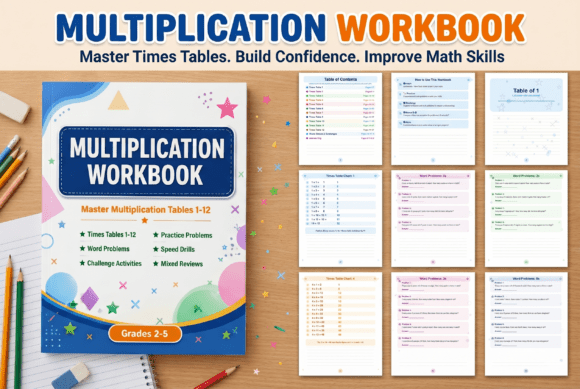
The 🔢 Multiplication Master Multiplication Workbook for Grades 2-5 addresses this directly. By systematically building from the table of 1 to the table of 12, it ensures that no gaps are left behind. This is especially relevant for grades 2-5, a window where students either solidify their number sense or begin to fall behind. The workbook’s 120-page structure provides enough repetition to achieve automaticity without becoming monotonous, thanks to varied formats like charts, vertical equations, and real-world problems.
Workbooks as Tools for Independent Learning
Another trend driving interest in multiplication workbooks is the growing emphasis on student-led learning. Parents who work from home, homeschooling families, and tutors are all looking for resources that a child can use with minimal supervision. A well-designed workbook functions almost like a self-guided curriculum. The 🔢 Multiplication Master workbook supports this by organizing pages into clear learn, practice, and challenge sections. A student knows exactly what to do on each page, and the gradual increase in difficulty provides a natural sense of progression and accomplishment.
For marketers and content creators in the education space, this is a key observation: the best-selling workbooks are those that empower the learner rather than depend on a teacher’s constant input. Autonomy is a powerful motivator, and workbooks that respect a child’s ability to work independently are more likely to be used consistently.
Practical Examples That Reveal Deeper Value
Consider a typical scenario in a second-grade classroom. A child is introduced to the concept of multiplication as repeated addition. They learn the table of 1 and 2 with relative ease. But when the table of 3 arrives, some students hit a wall. The 🔢 Multiplication Master workbook anticipates this. Page 15 in Section 1 uses a structured layout that breaks the table of 3 into smaller, manageable chunks. Instead of facing a daunting column of numbers, the student sees patterns—3, 6, 9—and recognizes that each step adds three. This pattern recognition is the seed of algebraic thinking.
Now jump to a fourth grader working on the table of 8. The workbook’s reference chart on page 41 offers a clear, easy-to-read visual that groups products in a way that highlights symmetry. The student notices that 8 x 4 is the same as 4 x 8, reinforcing the commutative property. This is not a concept they need to memorize separately; it emerges naturally from the practice. By the time they reach the vertical multiplication drills on page 55, the facts are no longer isolated—they are part of a connected web of understanding.
These small, well-designed moments are why professionals who evaluate educational resources often recommend this particular Multiplication Workbook over generic alternatives. The intentional progression, the use of reference points, and the mix of formats all reflect a deep understanding of how children learn math.
Why Parents, Educators, and Entrepreneurs Are Paying Attention
The market for supplemental math materials is crowded, but a workbook that delivers genuine results stands out. Parents are paying attention because they see their children’s confidence grow. A child who was hesitant to attempt multiplication begins to raise their hand in class. A student who relied on counting on their fingers starts to recall facts instantly. These are the outcomes that make a Multiplication Workbook worth the investment.
Educators are paying attention because the workbook aligns with standards and research. The focus on mental math, pattern recognition, and real-world application supports the goals of most elementary math curricula. Tutors and learning centers value the 120-page format because it provides weeks of structured practice without requiring additional prep time.
Entrepreneurs and content creators in the education space are paying attention because the success of this workbook reveals a clear market need: parents want resources that are both effective and easy to use. The 🔢 Multiplication Master Multiplication Workbook for Grades 2-5 meets that need with a professional, polished design that inspires trust. For anyone building a brand around learning tools, this workbook offers a case study in how to combine pedagogical rigor with user-friendly presentation.
Changing Expectations for Math Practice
What people want from a Multiplication Workbook has evolved. It is no longer enough to print a grid of facts and call it a day. Today’s parents and educators expect intentional scaffolding, variety in practice types, and evidence-based strategies. They want the workbook to teach, not just test. They want the child to understand why 6 x 7 is 42, not just memorize it.
The 🔢 Multiplication Master workbook reflects these changing expectations. Each section is built around a clear learning objective. The foundational pages emphasize concept development. The mid-range mastery section reinforces fluency through repetition and application. The challenge sections push students to apply their knowledge in new contexts. This structure mirrors what we know from cognitive science about how to build durable learning: introduce, practice, apply, and extend.
Connecting Multiplication Mastery to Broader Life Skills
At first glance, a multiplication workbook might seem like a narrow academic tool. In reality, the skills it builds are foundational for a wide range of life competencies. Mental math fluency is essential for managing personal finances, estimating quantities, making quick decisions, and even understanding probability and risk. The discipline of working through a structured set of exercises builds study habits and perseverance. The confidence that comes from mastering a challenging subject spills over into other areas of learning.
For professionals and entrepreneurs, the lesson is clear: the tools that build strong math skills are not just for school. They are investments in cognitive development that pay dividends for years to come. Whether you are a parent looking for a resource to support your child, an educator seeking a reliable supplement, or a content creator designing the next generation of learning products, the Multiplication Workbook remains a vital part of the conversation.
Final Thoughts on Choosing the Right Multiplication Workbook
Not all workbooks are created equal. The best ones, like the 🔢 Multiplication Master Multiplication Workbook for Grades 2-5, are built on a clear understanding of how children learn. They combine gradual progression with varied practice, pattern-based strategies with real-world context, and rigorous content with engaging layout. They respect the learner’s need for structure while providing enough challenge to promote growth.
In a world that increasingly values speed and convenience, taking the time to build solid arithmetic skills might seem old-fashioned. But the truth is that math fluency is more important than ever. It is the foundation for STEM learning, logical reasoning, and informed decision-making. A Multiplication Workbook that helps a child master the tables from 1 to 12 is not just teaching math—it is building confidence, discipline, and a mindset for success.
Whether you are a parent guiding a second grader through their first encounter with multiplication or an entrepreneur looking for a product that genuinely helps families, the principles behind this workbook are worth understanding. Intentional design, cognitive science, and real-world relevance come together to create a tool that transforms boredom into mastery. And that is a result worth every page.